
Key takeaways
Meaning & Material: What defines tweed and why there are so many varieties
Tweed refers to a firm, virgin wool fabric woven in a twill weave. Its origins lie in the Scottish and Irish highland regions, where wool weaving was a livelihood for the rural population for centuries. What began as robust workwear was discovered by the British upper class in the 19th century for their country wardrobe; since then, tweed has stood for that unmistakably British style where heritage and a lived way of life meet.
Three characteristics define every tweed: the virgin wool fiber as the material base, the twill weave as the weaving method, and the multi-colored dyed yarns that give the fabric its characteristic depth. The differences between the individual tweed types result from their region of origin, sheep breed, yarn processing, and woven pattern. Each region has developed its own methods over generations, tailored to the climate, available animals, and local tradition.
Harris Tweed: the world's only legally protected tweed
Harris Tweed is the best-known and most comprehensively protected of all tweed fabrics. Its home is in the Outer Hebrides, an island group off the northwest coast of Scotland; the most important weaving mills are found on the islands of Lewis and Harris.
Origin and production of Harris Tweed: the Outer Hebrides
The Outer Hebrides are an Atlantic-influenced island chain with a harsh climate, barren soils, and a weaving tradition that dates back several centuries. On the islands of Lewis, Harris, Uist, and Barra, Harris Tweed is still hand-woven today, often in the weavers' own homes. Precisely this small-scale, decentralized production is legally prescribed and fundamentally distinguishes Harris Tweed from any industrially manufactured competing fabric.
The Harris Tweed Act 1993 and the Harris Tweed Authority
In 1993, the British Parliament passed the Harris Tweed Act. Since then, the designation "Harris Tweed" may only be applied to fabrics that meet three clearly defined conditions: They must be made of pure virgin wool, be hand-woven in the Outer Hebrides, and be officially certified by the Harris Tweed Authority. The Authority is based in Stornoway on the Isle of Lewis and conducts regular inspections. Every woven meter receives a numbered authenticity label, which is later visibly sewn onto the finished garment.
The Orb Mark as a seal of authenticity
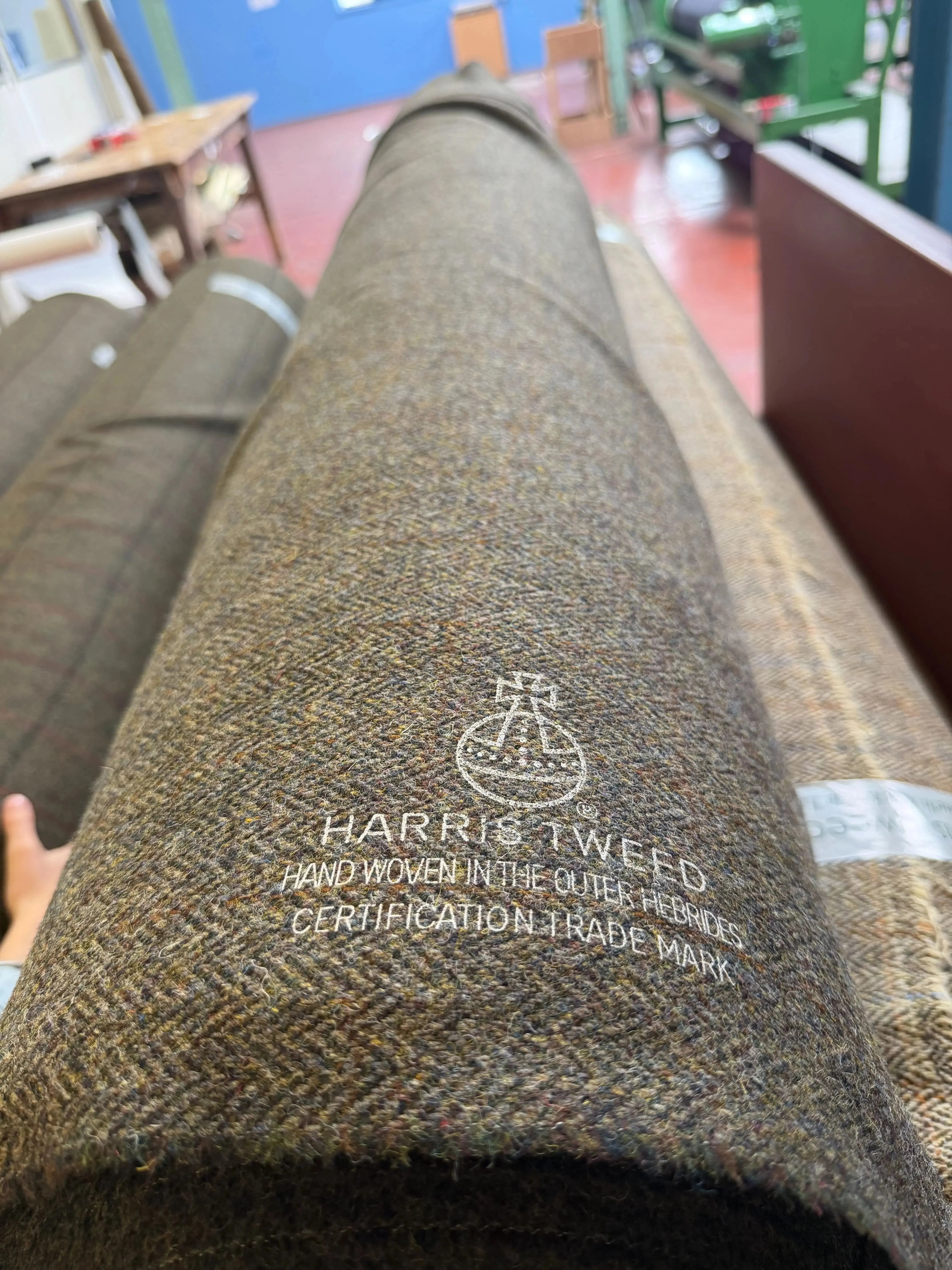
The official mark of authenticity is the Orb Mark, a crest featuring an orb and a Maltese cross. It was registered as a trademark in 1910, making it one of the oldest registered trademarks in Great Britain. Those who own Harris Tweed will find the Orb Mark on the sewn-in label, usually in the inner lining or on the sleeve. Without this marking, it is not genuine Harris Tweed, but an imitation or a fabric in the Harris Tweed style. A detailed guide to authenticity verification can be found in the Orb Mark guide.

Detailed view of the Orb Mark label on a Wellington of Bilmore jacket
Characteristics and typical uses of Harris Tweed
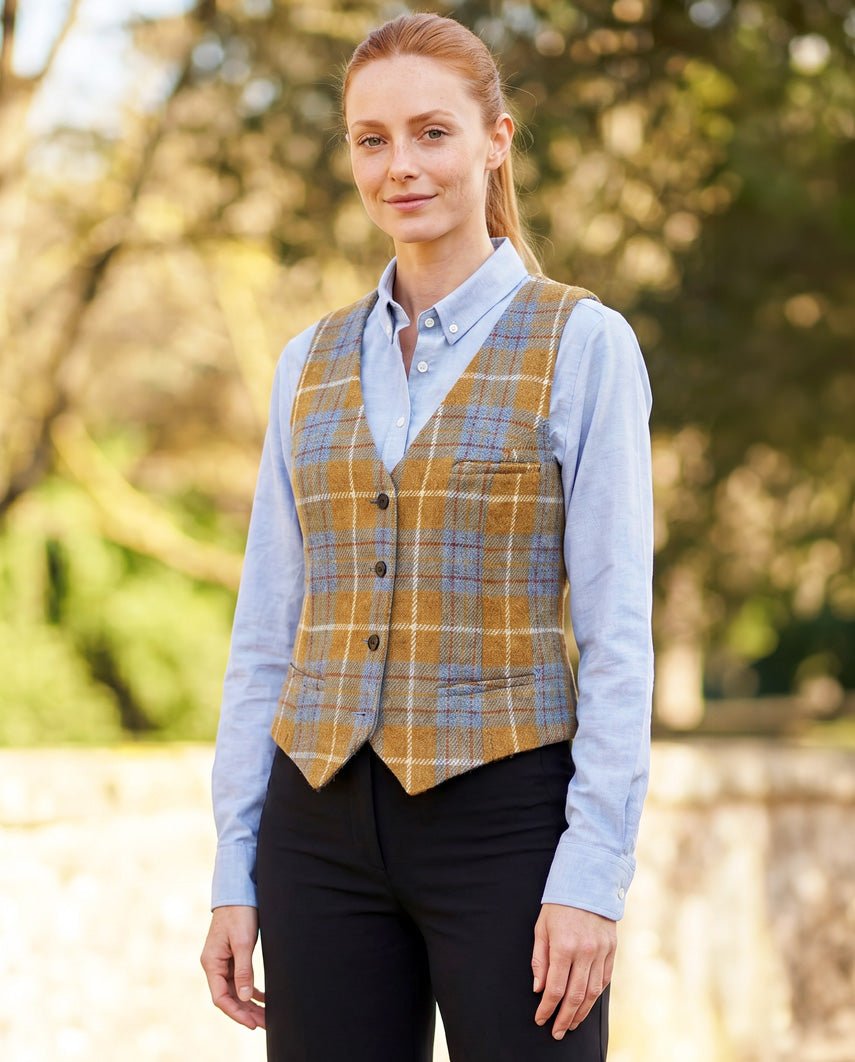
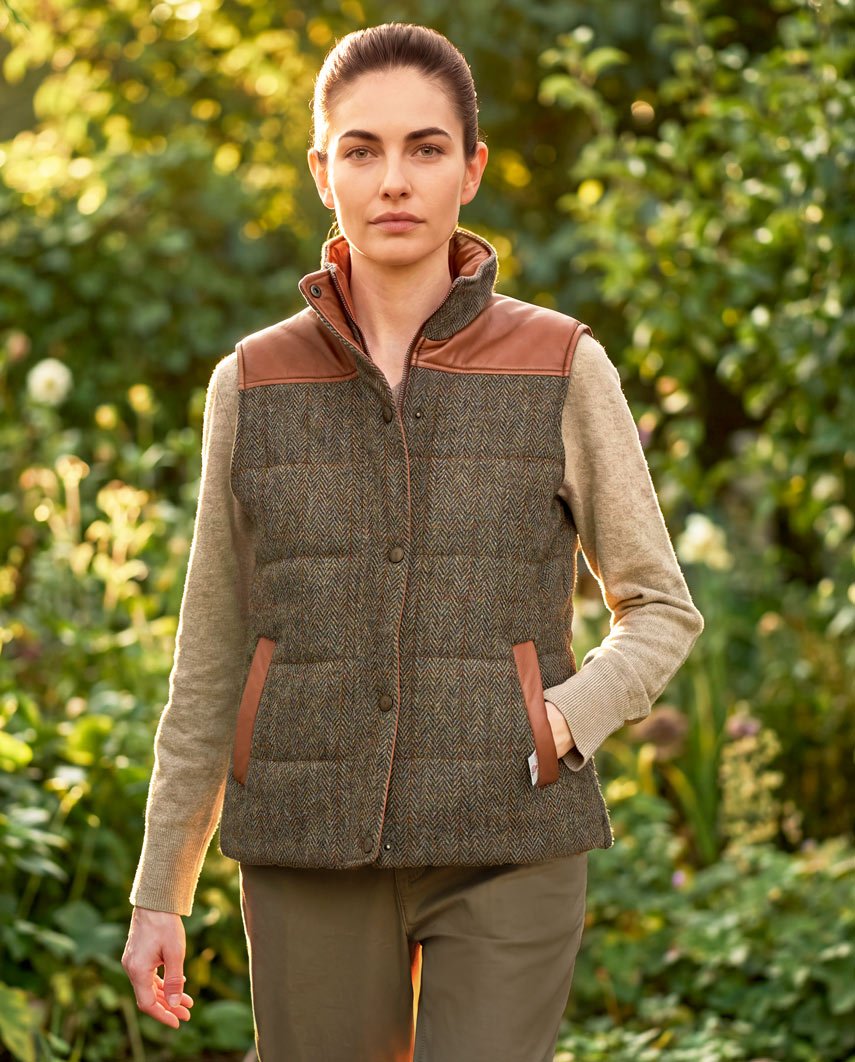
Harris Tweed is heavy, dense, and deeply colored. The multi-colored yarn dyeing creates that multi-dimensionality of the color surfaces that only truly reveals itself in close-up: from a distance, the fabric appears calm and rich, but in close-up, the eye discovers fine color nuances that make each tweed a distinctive unique piece. A high-quality Harris Tweed jacket will accompany its wearer for decades with good care. Typical uses include jackets, coats, waistcoats, trousers, and the classic flat cap. Wellington of Bilmore exclusively uses original, certified Harris Tweed.

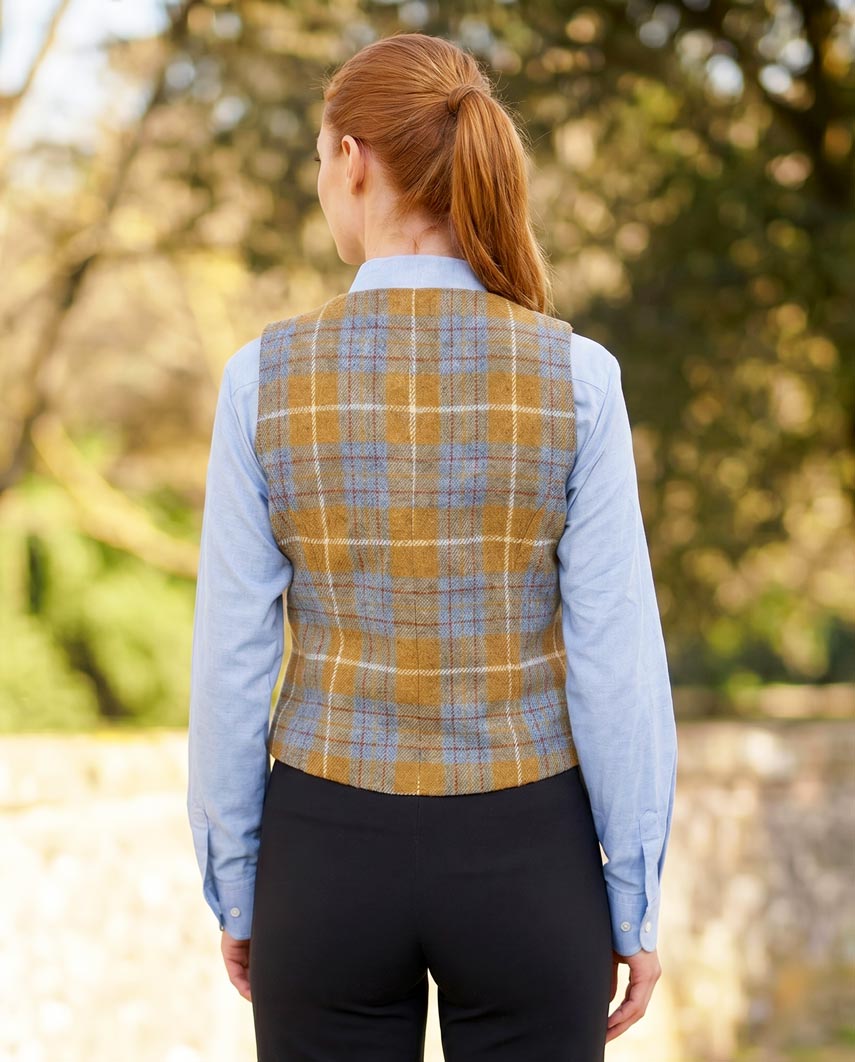
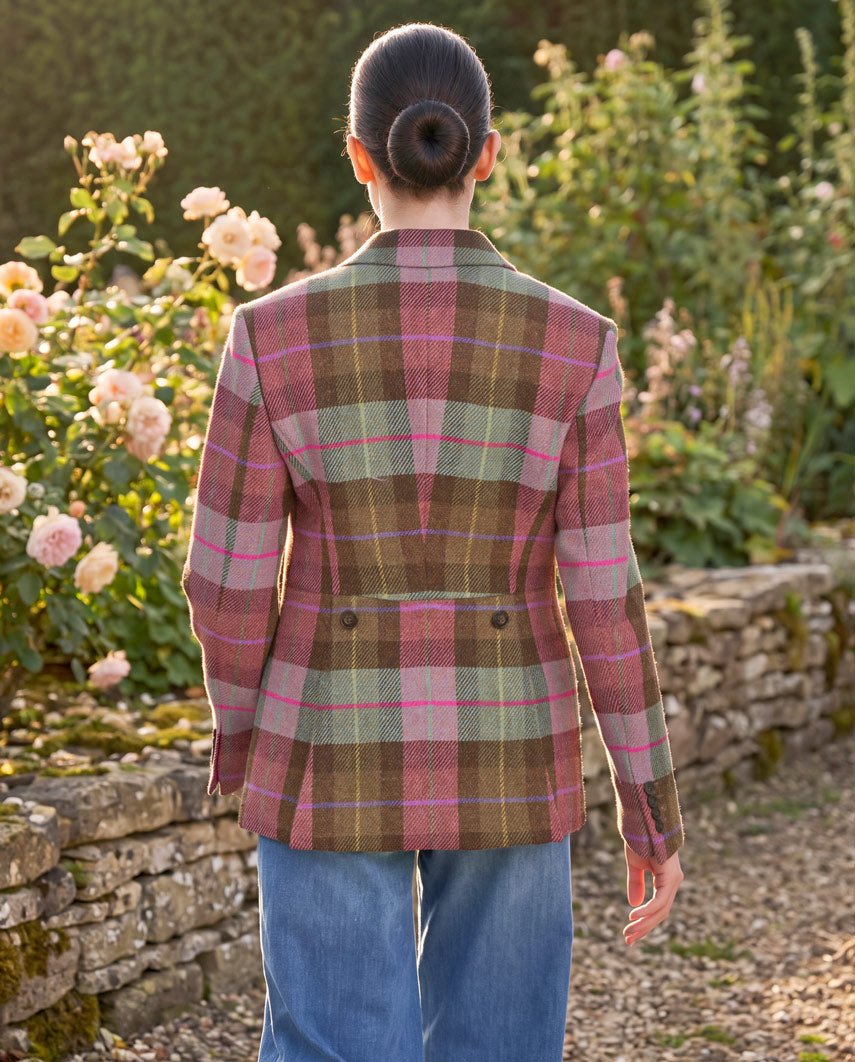
Detailed view of the Wellington of Bilmore Harris Tweed jacket "London" in Olive-Blue Overcheck
Donegal Tweed: the Irish classic with an accent
Donegal Tweed originates from County Donegal in the far northwest of Ireland. Unlike Harris Tweed, Donegal Tweed is not protected by an act of parliament; however, in textile tradition, the name has for generations stood for a clearly recognizable style with its own character.
Characteristic: the colorful flecks
The hallmark of Donegal Tweed is the small, multi-colored yarn knots, which are called "neps" in technical jargon. They are randomly scattered throughout the fabric and are created by interwoven, contrast-colored yarn particles. From a distance, the fabric appears calm and uniform; in close-up, the eye discovers the fine splashes of color that give Donegal Tweed its almost painterly depth.
Characteristics and typical uses of Donegal Tweed
Donegal Tweed is usually somewhat lighter than Harris Tweed and is often used for jackets, suits, and coats. One of the most traditional Irish manufacturers is Magee of Donegal Town, founded in 1866. Those looking for a vibrant fabric with unmistakable character will find Donegal Tweed to be an expressive alternative to the more subtle Scottish varieties.

Detailed view of Donegal Tweed
Note: Donegal Tweed is also available as knitting yarn
A small but important clarification: The term "Donegal Tweed" is also used for a well-known knitting yarn offered by several manufacturers, including Lang Yarns. This yarn imitates the typical Donegal look in knitting but has nothing to do with the fashion fabric itself. Those looking for the classic ready-to-wear fabric will find it under terms like "Donegal Tweed jacket" or "Donegal Tweed fabric for ready-to-wear".
Shetland Tweed: light Scottish tradition
Shetland Tweed comes from the Shetland Islands, a subarctic archipelago north of the Scottish mainland coast. Characteristic is the wool of Shetland sheep: fine, soft, yet durable.
Characteristics and properties of Shetland Tweed
Shetland Tweed is significantly lighter than Harris or Cheviot Tweed. The wool has a soft hand, scratches comparatively little, and takes on color particularly vibrantly. Tweeds in muted natural tones are as common as intensely colored variants, which the fabric reproduces very vividly due to its fine fiber. These properties make Shetland Tweed comfortable to wear, even directly on the skin or with finer shirts.

Detailed view of Shetland Tweed
Areas of application
Due to its lighter weight, Shetland Tweed is particularly suitable for transitional jackets, lighter blazers, and knitwear. A classic Shetland jacket is a pleasant alternative to heavier Harris Tweed for spring and autumn.
Cheviot Tweed: robust and wintry
Cheviot Tweed comes from the Scottish-English border region around the Cheviot Hills. The eponymous Cheviot sheep have been bred there for centuries for their coarse, robust wool.
Characteristics and properties of Cheviot Tweed
Cheviot Tweed is the heaviest and densest of the fabrics presented here. The wool is coarser than Shetland Tweed, and the fabric feels firm and compact. These properties make Cheviot Tweed extremely durable and warm; in return, it is somewhat stiffer to the touch than the other tweed types.

Detailed view of Cheviot Tweed
Areas of application
Cheviot Tweed is mainly used for heavy winter coats, country jackets, and classic riding apparel. It is very present in classic coat and outdoor ready-to-wear; in the fashionable tweed world for blazers and suits, it takes a back seat to Harris and Donegal.
Tweed types in direct comparison
Which tweed is suitable for which garment?
The choice of the right tweed fabric depends on the garment, occasion, and desired effect. Harris Tweed is the first choice for high-quality blazers, coats, and waistcoats that are meant to last for generations. Donegal Tweed is excellent for suits and blazers with a distinct character, especially when a lively, slightly rustic heritage look is desired. Shetland Tweed is recommended for lighter transitional fashion and for wearers who appreciate a particularly soft feel. Cheviot Tweed is the right choice for robust winter coats and country outerwear where durability and warmth are paramount.
Original Harris Tweed
Harris Tweed at Wellington of Bilmore
Wellington of Bilmore has been a traditional German house for classic, British-inspired clothing since 1899. Harris Tweed has been the heart of our collection for decades. Every one of our Harris Tweed pieces bears the official Orb Mark authenticity label and comes directly from the authorized weaving mills of the Outer Hebrides. Discover our Harris Tweed collection for men and women, featuring blazers, coats, waistcoats, trousers, and flat caps, crafted for those who value timeless elegance and a true sense of British lifestyle.
Frequently asked questions about tweed types
What is Harris Tweed?
Harris Tweed is a hand-woven virgin wool fabric from the Outer Hebrides in Scotland. It is the only tweed worldwide whose production is protected by its own law, the Harris Tweed Act 1993. Genuine Harris Tweed bears the sewn-in Orb Mark authenticity label of the Harris Tweed Authority.
What is special about Harris Tweed?
What makes Harris Tweed special is the combination of legal origin protection, craftsmanship, and more than a century of heritage. It must consist of one hundred percent virgin wool, be hand-woven exclusively on the Outer Hebrides, and be officially certified by the Harris Tweed Authority. No other tweed in the world is subject to comparably strict production requirements.
What is the difference between tweed and Harris Tweed?
Tweed is the generic term for a coarse, sturdy wool fabric in twill weave. Harris Tweed is a legally protected tweed variant that is exclusively hand-woven on the Outer Hebrides and bears the official Orb Mark label. So, every Harris Tweed is tweed; not every tweed is Harris Tweed.
Which is the best tweed?
There is no single "best" tweed because the different types of tweed serve different purposes. Harris Tweed is considered the most prestigious because it is the only tweed worldwide protected by an act of parliament and must be hand-woven. Donegal Tweed is often perceived as the most characterful, Shetland Tweed as the softest, and Cheviot Tweed as the most robust. Which is the best depends on the occasion, material preference, and personal style.
Which tweed is the highest quality?
Quality cannot be universally answered because the types of tweed serve different quality standards. Harris Tweed offers the strictest legal quality assurance and the most pronounced heritage authority. Donegal Tweed is considered very high quality in the field of lively, characterful fabrics. Shetland Tweed scores with particularly fine wool quality. Which is the highest quality depends on the application and personal taste.
What is Irish tweed fabric?
Irish tweed primarily refers to Donegal Tweed from the eponymous county in northwest Ireland. It is usually slightly lighter than Harris Tweed and recognizable by the characteristic colorful slubs in the yarn. Among the most famous Irish processors is the House of Magee in Donegal Town, founded in 1866.
Which tweed is the warmest?
Cheviot Tweed is usually the warmest tweed due to its dense weave and coarse wool quality. Harris Tweed also offers very good thermal performance but is somewhat lighter to the touch. Shetland Tweed provides the least warmth, but is suitable for transitional seasons and milder days.
Can you wear tweed in summer?
Classic tweed fabrics are not suitable for high summer. For spring and late summer, lighter variants such as Shetland Tweed or special summer blends are available, which combine the tweed look with a lower fabric weight.
Which tweed is suitable for a wedding?
For a classic and elegant wedding, a subtly patterned Harris Tweed in Glen Check or fine herringbone is the first choice. For an autumnal or country wedding, Donegal Tweed with its lively character also comes into its own. The complete suit is traditionally worn as a three-piece with a jacket, waistcoat, and trousers, ideally in muted natural tones. Wellington of Bilmore offers a complete range of Harris Tweed suits.
Where is Harris Tweed made?
Harris Tweed is woven exclusively on the Outer Hebrides in Scotland, primarily on the islands of Lewis and Harris. Three authorized weaving mills organize the production. The entire production remains in the Hebrides; neither the spinning nor the dyeing or weaving may take place elsewhere.
Why is Harris Tweed unique?
Harris Tweed is unique because its production is legally protected by the Harris Tweed Act 1993. Three points make it unmistakable: It is produced exclusively on the Outer Hebrides in Scotland, it is hand-woven in the homes of the weavers, and every meter bears a unique identification number on the sewn-in Orb Mark label.
What is the difference between Harris Tweed and Donegal Tweed?
Harris Tweed comes from the Outer Hebrides in Scotland, is legally protected, hand-woven, and certified by the Orb Mark. Donegal Tweed comes from County Donegal in Ireland, is not protected by an act of parliament, and is recognizable by its characteristic colorful slubs (small yarn knots in contrasting colors). Harris Tweed is usually heavier and denser, Donegal Tweed more vibrant in color.
What is Shetland Tweed?
Shetland Tweed is a light, soft tweed fabric from the Shetland Islands north of the Scottish mainland coast. Characteristic is the fine wool of Shetland sheep, which has a soft feel and absorbs color particularly vividly. Shetland Tweed is primarily suitable for transitional jackets, light blazers, and knitwear.
What is Cheviot Tweed?
Cheviot Tweed is a heavy, dense tweed fabric from the Scottish-English border region around the Cheviot Hills. The coarse, robust wool of the Cheviot sheep makes it one of the warmest and most durable tweed fabrics available. Cheviot Tweed is primarily used for heavy winter coats, country jackets, and classic riding attire.
How much does a high-quality tweed blazer cost?
A high-quality tweed blazer made from original Harris Tweed typically costs between 350 and 700 Euros. Wellington of Bilmore blazers are at the lower to middle end of this range due to direct sales from the manufacturer. Tailor-made models or limited pieces from the UK can be significantly more expensive. By paying attention to the Orb Mark label of the Harris Tweed Authority, you avoid cheap imitations without legal proof of authenticity.
Related articles about Harris Tweed
-
Identifying Original Harris Tweed: Orb Mark and Certificate of Authenticity
-
Tweed Patterns at a Glance: Houndstooth, Glen Check, Herringbone, and More